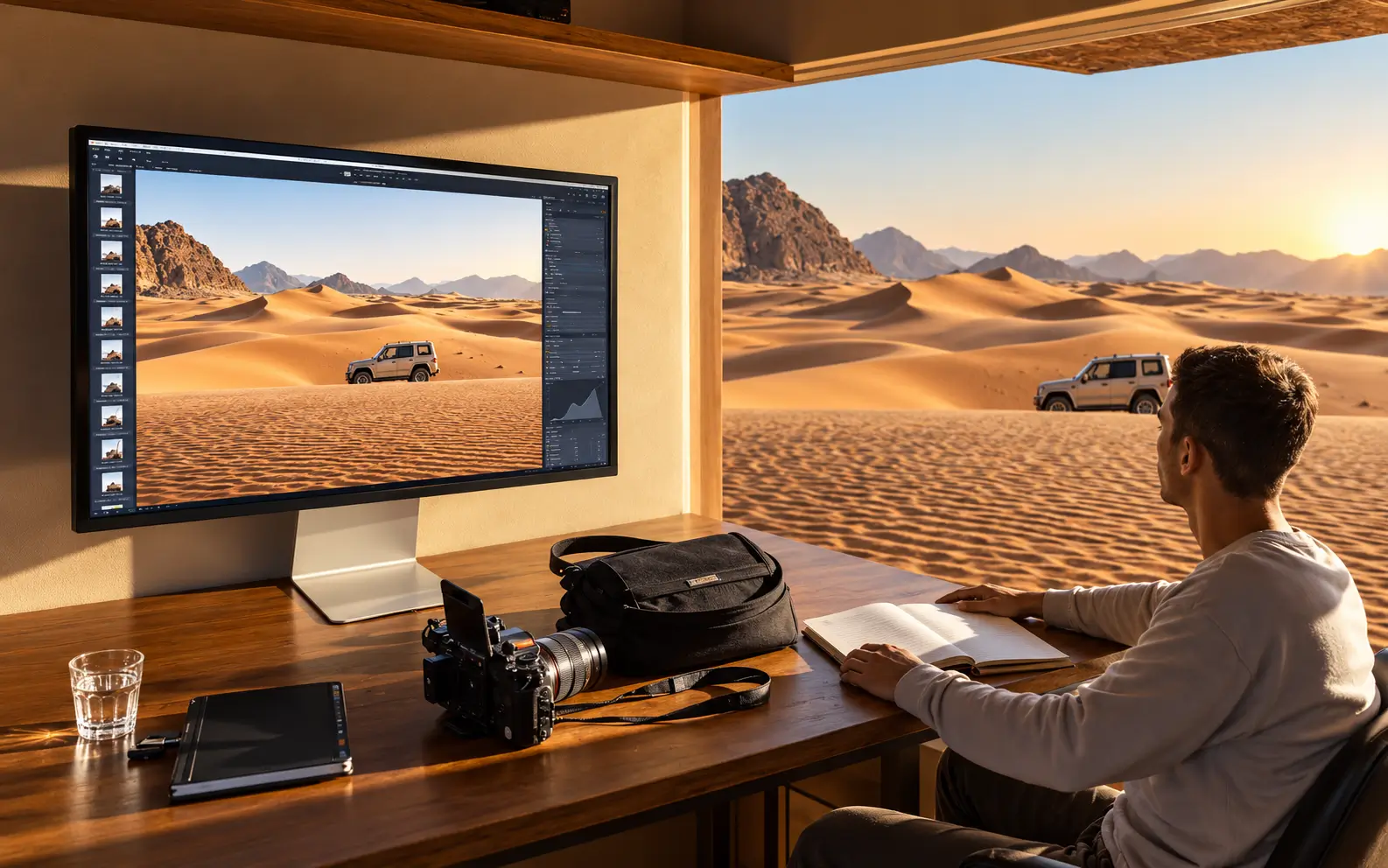
You left for the salt lake at the correct time; the colour was remarkable and you took approximately ninety photographs.
At home the colours are grey. They are not obviously incorrect, merely flat. The turquoise is less bright than before. The white salt has become a little beige. The distant edge of the frame has a softness about it which the lens shouldn’t produce, and none of the things you remember being there are actually shown in the picture.
This is true in comparison to most other places, and in almost all cases the reason has nothing to do with the camera; the air, the light and the heat work together in particular ways which the sensor finds difficult to deal with but which the human eye manages easily.
Almost all of it is recovered. The image model family developed by Nano Banana, which includes image editing tools from Higgsfield, is designed for editing not for generation, and this proves to be the appropriate tool to use in the case of a photograph that was correct when it was taken but became wrong later.
Before getting to all that, there is one legal point which is more important than any of the technical matters discussed in this article.
What does the law actually say about photographing people?
You must not take photographs of people without their permission; that is the brief statement and it is not a matter of courtesy in this case, it is a legal requirement.
The UAE’s laws concerning privacy and cybercrime include taking photographs of people without their consent as well as publishing those photographs online, and fines for such actions are actual and have been imposed.
It always manages to deceive visitors, since street photography is common in many places but not in this one. For example, a spontaneous photograph of someone in a souq, a stranger walking through your shot at a well-known site, or an image of a family on the beach—all of these are issues.
Crowd scenes in a wide shot in which no one can be identified are classed differently from a close-up portrait of a stranger, but the rule to follow is straightforward: if someone is identifiable and you have not asked them, then do not use the image, and by no means publish it.
By the way, asking works since most people say yes and the resulting photograph is typically better than a candid one would have been because the person is looking at you.
Children should not be taken unless they are yours or the parent who is beside you agrees.
Which places are restricted?
The amount expected by tourists goes beyond what is indicated, and the signs are not always clear.
Access is restricted to government buildings, military installations, airports, ports and certain kinds of infrastructure, as well as to a number of palaces and official residences, since some of these buildings are visually impressive and therefore tend to be photographed by people without realising it.
With regard to private property such as shopping centres, hotels and a great many other attractions, permission is needed if you want to take anything other than casual personal photographs. Tripods in particular draw the attention of security personnel since they usually take the presence of a tripod as an indication that commercial work is being carried out, irrespective of what your real intention is.
Drones must have permits, and this rule is strictly enforced with serious consequences.
The rules vary from emirate to emirate, and that is something that people overlook. What is acceptable in one place might not be acceptable in another.
If you’re uncertain, it’s better to ask an official rather than make an assumption. The security personnel at most events will give you a direct answer and are usually okay with it.
Why is the midday light so punishing?
Since the sun is nearly directly overhead and there is almost nothing to mitigate its intensity.
At midday the light comes straight down on everything, so that there are short and sharp shadows, the highlights on any light-coloured surfaces are blown out, and if you are taking photographs of people who have given their permission the faces look awful.
Architecture is especially affected. When a white or sandy-coloured building is exposed to the sun vertically, the illuminated parts become completely white while the shaded side turns nearly black, and no sensor is able to capture both extremes.
There is likewise no cloud for most of the year since cloud acts as a diffuser and without it the contrast is as high as it can be.
In practice, this means that you should stay indoors during midday; it’s not a strict rule, merely that the photographs taken between about eleven and three will be the worst on the card and that knowing this beforehand avoids disappointment.
Is haze what ruined your distant shots?
The reason why the far side of every extensive landscape appears faded is that you eat your contrast.
Two things occur. There generally is dust in the air, and this dust scatters the light so that the contrast diminishes over a distance. Also, above hot sand or asphalt the air shimmers, which blurs anything that is far away no matter how good your lens is.
In Nano Banana some of the dust can be recovered; through editing the contrast and colour a good deal of it is brought back since the detail had been recorded even if the separation was reduced.
The shimmer doesn’t exist because heat haze distorts the light before it gets to the sensor, meaning the information was never actually recorded. There’s no way of recovering it and anyone who says otherwise is trying to sell you something.
This means that distant subjects should be shot as early as possible since the air is calmer, the ground has cooled during the night, and the haze is much lower by about nine in the morning.
Does the heat affect the equipment itself?
Yes, in one way or another, it happens to at least one person.
When you get out of the air-conditioned car and enter the coastal humidity, your lens fogs over immediately. It doesn’t just fog a little—it fogs completely, both inside and outside, and this takes between two and fifteen minutes depending on the conditions.
You can’t do anything to speed up the process much, since cleaning the front pane only removes the moisture from the outside and the inside remains fogged.
The solution lies in anticipating the need. Take the bag out of the air conditioning at ten or fifteen minutes’ notice before you actually want to use the camera. Put it in the boot not in the cabin. Or just accept that the first few minutes at any new location are a loss.
The other option is to change lenses outside if there’s any wind, since the sensor dust picked up in the desert will remain with you for the entire trip; in that case, you should do it in the car with the windows closed or leave it alone.
Which hours are genuinely worth setting an alarm for?
More than early, indeed earlier and even earlier than you would like.
The best light available here by a long way is the one that occurs one hour after sunrise. It has a low angle, is warm, produces long shadows, has very little haze, and there is almost nobody else around. The desert in particular appears as if it were a totally different place.
The time just before sunset is about as suitable and much more crowded.
Afterwards, during blue hour, the skylines are visible because the buildings light up, the sky retains deep colours for about twenty minutes, and the contrast between the artificial light and the remaining daylight is something that can be managed, unlike in full night.
Winter is useful for the use of light. Since the sun remains lower in the sky for a longer period, the good light is extended on both sides of the day and the conditions during the middle hours are therefore less severe than they are in summer.
If you have only the midday hour, then take photographs of interior rooms, the shaded bazaars, the covered passages and all other places where the light is being reflected rather than direct.
How much does Nano Banana actually bring back?
The amount that the conditions took, more than you would expect just by looking at the files.
With the Nano Banana the contrast and colour are effective on hazy distant shots, since in those cases the separation breaks down but the detail remains underneath.
The nano banana is able to carry out shadow recovery on the dark side of buildings, which is the side that contains most of the interesting architectural details and which the sensor shows as black.
Emphasise the recovery of highlights on light-coloured surfaces, using whatever the file still contains. Although fully blown highlights are lost permanently, a great deal of what appears to be blown when viewed on screen can actually be recovered.
The Nano Banana colour cast correction is necessary because dust in the air causes everything to appear slightly warm and flat in a way that isn’t noticeable until you compare it with a corrected version.
You will end up with some sensor dust, and Nano Banana is able to remove it more quickly than you can do by hand over ninety frames.
So that with respect to a set, the sunrise photographs and the blue hour photographs taken on the same day should be counted as coming from the same outing rather than appearing as if they were from two different trips.
Nano Banana is suitable because it alters the name and leaves everything else unchanged. This is important in the case where the photograph was basically correct and all that needed doing was to reverse the conditions.
What should stay exactly as photographed?
A place which seems obvious and is usually overlooked.
It would be wrong to use Nano Banana to get rid of people and make a place appear to be empty. A photograph of a busy attraction showing it as deserted is a misleading representation of what it’s really like to visit such a place, and anyone who visits on your advice will realise this.
Do not take away the construction, the scaffolding, the hoarding or any other item that is actually there, since this city is permanently built and that is one of the reasons for its appearance.
You should not introduce a sky that you didn’t have; throughout most of the year the sky is flat and white here. Introducing an alternative is to create something that never existed.
Leave all landmarks, buildings and landscape features alone.
Don’t move things around in order to improve the composition. Crop them, not rearrange them.
The question we need to decide is this: will a person who is in that position tomorrow be able to identify what the photograph shows? Clear up the haze and then leave the crane.
Can a whole trip be kept consistent?
Instead, organize the process by session, not by location.
The photographs taken at sunrise were all taken under the same conditions, and those taken at blue hour were likewise. If you group them in this way, then one Nano Banana treatment is sufficient for each group, and this method is faster while at the same time giving a more coherent result than treating each frame individually.
Higgsfield combines the functions of correcting, organising and exporting in a single AI creative suite, something that only becomes important when you’re carrying out these tasks in a hotel room from a laptop rather than at a proper desk.
The fact that a Nano Banana treatment has been saved also means that a match from next winter will be included, and over a number of years this results in a collection of folders that appears to form a body of work.
The originals are kept apart from the corrected versions. In cases where things change so rapidly, the unaltered file serves as a record of what a place looked like on a specific date, and that aspect becomes more interesting rather than less so.
Label them by location and date in Higgsfield, since in three years you’ll not remember which tower it was.
What would one outing take?
Twenty minutes, that being less than the time it takes to get home.
Shoot first, heavily, before anything gets to Higgsfield; most of the shooting done during the morning consists of repetition and keeping all of it slows down the rest.
Sort the remaining ones by the light; for example, at sunrise, mid-morning, or whatever else.
Make sure that one frame is correctly adjusted on the Nano Banana until it appears as it should, rather than as it looks on the screen, and then use that as your standard.
Use the Nano Banana treatment on the entire group, check a few of them against the original and correct the dust spots.
Take only what is necessary and store the original documents in Higgsfield.
If you look at the entire set together, that’s the only way to determine whether the treatment is too heavy; although each item looks all right on its own, it’s when they are placed side by side that overcooking becomes apparent.
Conclusion
No one returns from a visit to the salt lake or from the dunes having brought back descriptions that match what they actually saw; the air absorbs the contrasts, the sun takes away the shadows, and the heat removes the sharpness from anything in the distance.
The majority of it can be recovered and Nano Banana looks after it without interfering with any of the frame parts you didn’t ask about. Higgsfield makes an entire journey appear as a single journey, which is what distinguishes a folder from a set.
There is one point which is absolutely non-negotiable and that has nothing to do with editing; you should ask permission before taking someone’s photograph, make sure you know where you are standing, and remember to take the scaffolding away when you have finished.
The last point is simply being honest; the first two will prevent you from entering a conversation you don’t want to have.
Read Also: Ajman Gold Market