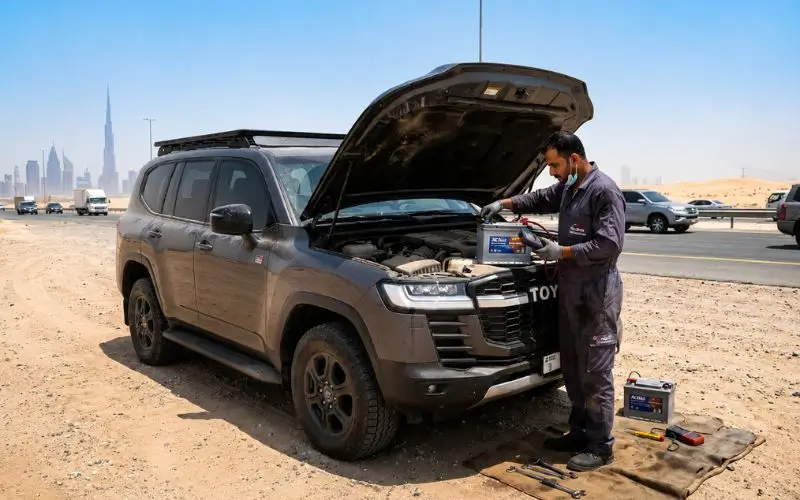
Dubai is among the world’s leading areas for the use of SUVs. The roads between Deira and Dubai Hills are mainly used by Land Cruisers, Patrols, Fortuners, Pajeros and Range Rovers. It’s not surprising why. SUVs are equally at home in the city, on the highway and even on the occasional desert trip.
However, most Dubai car owners are not aware of the battery usage that an SUV presents until the car battery dies when you need it most. The Performance Batteries are one of the most heavily charged parts of any SUV driving in the UAE, especially as it’s subjected to a larger engine, a heavier body, greater electronics power and the unrelenting heat.
In Dubai, drivers who wish to avoid this issue rely on Sayara battery to deliver a true Amaron car battery in Dubai for handling the electrical load and heat conditions SUV owners encounter daily in the UAE.
Why a Standard Battery Is Not Enough for an SUV in Dubai?
A battery with good performance in a compact sedan isn’t going to be the same in a large SUV. The answer lies simply. SUVs are larger and use more electricity than other vehicles over time, have larger engines, and are subject to higher heat stress due to their size and use.
Based on the SAE J537 standard (referenced by Battery University), it is found that typical CCA specifications for a car range from 350A to 600A, with larger vehicles (trucks, SUVs) having much higher requirements.
The Land Cruiser and the Patrol are typical full-size SUVs that require 650 to 800 CCA and often more cranking power in diesel models, due to their higher compression ratios.
One of the most common battery failure issues faced by drivers in Dubai is having an undersized battery in their SUVs.
8 Reasons SUVs in Dubai Need Higher-Performance Batteries
1. Larger Engines Demand Higher Cranking Power
The battery is connected to the starter motor whenever the ignition switch is turned to the “on” position, sending a high surge of current to start the motor and ignite the engine. If you have a V6 or V8 engine, like in the Toyota Land Cruiser, Nissan Patrol, or Ford Explorer, it will take a lot more cranking power than a four-cylinder sedan engine.
This is the initial demand and is measured in Cold Cranking Amps. If a battery fails to provide the minimum CCA required for the SUV, it will have trouble starting the engine, particularly after hours in a Dubai car park and in direct sunlight.
When hard starts occur over time, the resulting battery wear is much greater than the battery’s design specifications.
2. Heavier Vehicles Put Greater Strain on the Electrical System
An SUV is much heavier than an ordinary car. The extra mass increases the stress on the engine, and this increased stress is similarly reflected in the increased load on the alternator and battery while operating all electrical loads simultaneously.
When the road is less busy (e.g., Al Khail Road or around the Dubai Frame interchange), the alternator’s spin rate is lower than the demand for a heavy electrical load. That space is filled in by the battery, and in a big SUV, it’s much larger than in a little one.
3. 4WD and Off-Road Systems Add Constant Electrical Demand
SUVs in Dubai are not only for urban driving but also for weekend excursions to the desert, such as Al Qudra, Lahbab, or the dunes of Liwa.
Use of 4WD, locking differentials, hill descent control and controlling terrain response systems all put extra strain on the battery.
These systems use power both in the standby and active states. These requirements cannot be met by a standard battery because it is not typically equipped with sufficient reserve capacity to withstand the demands, especially after driving a long time through soft sand under AC load in 45°+ heat.
4. High-Power Air Conditioning Systems Run Almost Year-Round
Compared with a compact car, the AC in an SUV is much more powerful. It must chill a considerable amount of air, often putting it through an entire cabin in three rows of seats.
The electrical load of a full-size SUV’s air conditioning at full load is much higher in Dubai’s summer than in a smaller vehicle.
This load operates in Dubai from the ninth month to the tenth month of the year. If the battery can’t meet this continuous demand without dropping its performance drastically, it’s not right for an SUV in this environment.
This extended load is carried by batteries that have higher performance and reserve capacity without the same rate of wear.
5. Advanced Safety and Driver Assistance Systems Never Switch Off
Advanced Driver Assistance Systems are installed in modern SUVs, like blind-spot monitoring, rear cross traffic alert, 360 camera systems, adaptive cruise control, lane-keep assist and automatic emergency braking. These systems use sensors, radar modules and processors which consume power constantly, active or not, during driving and when parked.
The sum of the stand-by draw of all these systems on an SUV equipped with a full complement of ADAS is significantly larger than on a standard vehicle. Without a good reserve capacity, the battery will not be able to withstand this idle load as the power dumps during lengthy parking periods, especially during Dubai’s hot summer, when the high temperatures accelerate the self-discharge process.
6. Towing and Payload Use Push the Electrical System to Its Limits
A lot of Dubai SUV owners tow boats, trailers or off-the-road equipment. All of this takes place during towing, placing a load on the engine, boosting alternator load, and engaging extra electrical systems such as trailer brake controllers, back lighting systems, and load-sensing suspension modules.
A normal battery that is just okay for regular SUV driving can quickly end up being an inadequate power source if towing is thrown into the mix. To be able to meet towing requirements without overloading the battery, higher-performance batteries are now available with more cranking power and high reserve capacity.
7. Longer Parking Periods in Extreme Heat Drain Batteries Faster
Several people in Dubai rely on their SUV as their main family car, and they leave their car without shade in shopping complexes, offices, or apartment complexes.
The heat in the engine bay of a large SUV parked in the direct sun in the summer months can cause rapid battery self-discharge.
The standby current the SUV consumes from the battery when the engine is not running, such as for air suspension levelling, keyless entry, security systems and telematics, can be enough to cause problems on the next cold start if the battery is low during a long workday.
Such a situation is managed without incident by a high-capacity battery that is resistant to heat and maintains charge.
8. Diesel SUVs Require Significantly More Starting Power
A diesel engine on an SUV (such as diesel versions of the Land Cruiser, Patrol and Prado, which are still popular in the UAE) needs a lot more cranking power to start up than a petrol engine.
In the case of the diesel engine, the air is compressed to a much greater degree before the ignition takes place, so the starter motor has to do more work and for a longer period of time to get the engine running.
The increased initial demand means that the battery has a much higher CCA rating than a petrol SUV of the same size. A common error is to fit a battery with a minimum petrol specification, and it is often found that this battery fails prematurely, especially when parked for long periods of time during Dubai’s summer months.
Signs Your SUV Battery Is Struggling in Dubai
It is important to recognise these warning signs before the battery fails:
- Engine cranking is slow or hard to do when the vehicle is first run on the day (particularly after being parked overnight)
- The start-stop system is turning itself off more often when driving in the city.
- Unusual behaviour when starting up the electronic systems, such as infotainment resets or warning lights that turn off after a minute
- Slow in response when switching into 4WD/terrain mode.
- A significant decrease in AC cooling efficiency at idle and at slow speeds is noticeable.
Each of these may be explained differently. However, if two or more are present in a car that is more than two years old, the first thing to do is have a battery test.
Choosing the Right High-Performance Battery for Your SUV
Not all high-performance batteries will fit into all SUVs. The answers depend on engine size, CCA draw, start-stop system and electronic equipment installed.
Amaron’s Pro range, such as the popular 105D31L model for use in Land Cruisers and Patrols, is designed specifically for use in large 4WD electrical systems and extended AC operation in warm climates. It uses a SilvenX Alloy grid technology to eliminate internal corrosion even at high temperatures, and is sealed, requiring no maintenance, in contrast to traditional batteries that lose electrolyte in Dubai’s heat.
An AGM-rated Amaron battery offers deep-cycle power and high recharging speeds to the vehicles equipped with start-stop systems and advanced electronics.
Conclusion
For example, SUVs in Dubai require a battery that’s used differently from the one in a standard vehicle. The combination of bigger engines, heavier electrical and 4WD systems, strong AC systems, advanced safety equipment and the extreme heat of the UAE climate is a strain on the battery that is difficult to maintain for long with just a regular replacement and with regular usage.
It’s not only about avoiding a breakdown when you select a battery with better performance that matches your SUV’s actual power needs. It helps you avoid the electrical short circuits, improper working of safety features and expenses of replacing or repairing batteries due to improper fitment. In Dubai, it’s the best time to get an SUV battery test before the summer season if you drive often and the battery is over two years old.
Read Also: Sobha Realty Metro Station