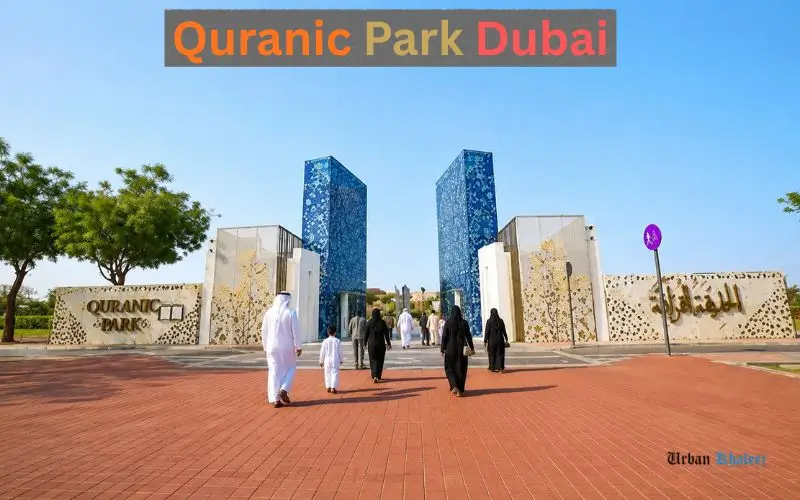
Quranic Park Dubai is a public park developed by Dubai Municipality around plants, stories, and miracles that were mentioned in the Holy Quran. It is a unique public park. The park has a land area of 64 hectares and is home to 12 themed orchards, the Glass House, Cave of Miracles, Prophet Moses Miracle Lake, Solar Trees, and children’s play areas. It has 51 plants named in Qur’ān in its orchards and information stands about them and their uses and Quranic references. The park’s blend of the natural and the cultural, with its family-friendly amenities and landscaped gardens, creates a unique space for people to enjoy the outdoors and explore Islamic history.
Quranic Park Dubai Overview
| Information | Details |
| Location | Al Khawaneej, Dubai |
| Completed | 2019 |
| Area | 64 hectares |
| Quranic Plants | 51 types |
| Themed Orchards | 12 |
| Main Attractions | Glass House, Cave of Miracles, Prophet Moses Miracle Lake |
| Children’s Play Areas | 2 |
| General Entry | Free |
| Paid Attractions | Glass House and Cave of Miracles |
| Best For | Families, nature and Islamic heritage |
| Public Transport | Metro + bus/taxi connection |
| Visit Duration | Around 2–3 hours |
Where Is Quranic Park Dubai?
Al Khawaneej is the area of the park in the east of Dubai. According to Dubai Municipality, Al Khawaneej is the project’s location.
The location is crucial since the park had to be placed away from Dubai’s high-rise districts. Rather, it is an integral part of the larger Al Khawaneej community and is a worthwhile place for visitors to visit alongside other attractions and leisure activities in the area.
Visit Dubai also pinpoints the attraction as Quranic Park in Al Khawaneej, thus confirming the location in this neighbourhood. The official tourism authority’s cycling information also points to a 19-kilometre Khawaneej Track for the local community and to connect with the Mushrif Park track.
The site might be particularly attractive to families and residents looking for an outdoor spot, instead of a shopping or entertainment centre.
What Is the Main Idea Behind the Park?
The idea is to showcase references to plants in the Quran and prophetic miracles in a contemporary context of a public park. Dubai Municipality describes it as a new method in designing public parks, which is heavily based on the Quran and Sunnah.
The botanical component of the project is based on 12 orchards. Each orchard represents a plant or a tree from the Quran, such as the orchards of grapes, palms and olives. Details of these plants and verses are available at points around these areas.
The educational concept is carried on within the Glass House and Cave of Miracles. The Glass House has been designed for the cultivation of plants in a controlled environment, and the Cave of Miracles has interactive technology for the presentation of prophetic miracles described in the Quran.
How Large Is the Park?
The built-up area of the project is currently listed by the Dubai Municipality as 64 ha or around 640,000 square metres. The official project page states that it was completed in 2019.
Size is a consideration when planning the visit. This is not a show for one house, or a single indoor show. Much of the learning is done outside, in the orchards, along the paths, in the protected shade and the landscaped areas.
There is also dedicated recreational infrastructure within the park. Two children’s play areas are available for children from ages 2 to 12, in addition to the green areas and walking spaces, according to Dubai Municipality.
Read Also: Best Places to Visit Near Dubai
What Makes It Different From Other Dubai Parks?
The key difference lies in the integration of nature, education, Islamic culture and technology in one place.
The orchards contribute the botanical component, and the information kiosks give visitors context information relating to the plants mentioned in the Quran. Controlled environment horticulture is added at the Glass House, and interactive displays with holograms and 3D mapping techniques are added at the Cave of Miracles.
Another aspect of the design is sustainability. There are also specially designed solar trees, inspired by Islamic art and geometry, set in the park, and park walkways are lit by an off-grid solar lighting system. The solar trees offer Dubai Municipality with solar lighting and charging stations.
The outcome is a place that can be enjoyed by all as a public green space and also explains the educational aspects of the Quranic plants and miracles.
Main Features at a Glance
The main features and amenities consist of:
- 12 themed orchards of Quranic plants and trees.
- 51 types of Quranic plants identified by Dubai Municipality
- Plants that need special growing conditions should be placed in the Glass House.
- The Cave of Miracles has seven exhibits.
- The Prophet Moses Miracle Lake.
- Off-grid solar lighting and solar trees.
- In the orchards, information kiosks are placed throughout the orchards.
- The shaded areas around the walking routes
- The park features two play areas designed for kids ages 2 to 12.
This mix makes the park much more than a landscaped recreational area. The gardens are open for visitors to walk through, view the plant displays, and enjoy the specialist attractions while taking advantage of the shade.
Quranic Park Dubai Attractions: Orchards, Glass House and Cave of Miracles
Many of the most interesting features of the park are not in a single building. The outdoor orchards serve as the basis for the botanical and educational component, and the Glass House and Cave of Miracles are more systematic experiences. The park is said to contain 12 orchards and 51 species of plants that are referenced in the Holy Quran, according to Dubai Municipality.
12 Quranic Plant Orchards
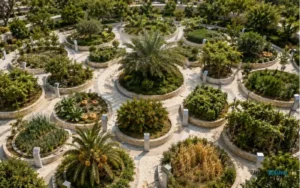
One of the most unique features of the park is the orchards. They are based on the plants and trees that have been mentioned in the Holy Quran, and Dubai Municipality has identified the following: grapes, dates, olives, pomegranates, figs, pumpkins, cucumbers, garlic, onions, wheat, lentils, ginger, basil and cumin.
Information kiosks are strategically positioned around the orchards to provide detailed information about the plants, their applications and benefits, along with the relevant verses from the Quran. This will allow visitors to experience the gardens, as well as the rationale behind the selection of specific plants in the park’s original plan.
The orchards are especially helpful for families because you don’t need to read a long description to enjoy the orchard. The visitors can roam the areas of landscape at their own speed, and use the points of information for extra context when they wish.
Glass House
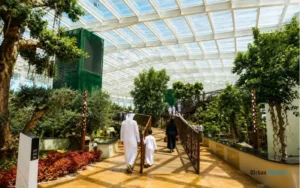
The park has two main paid attractions: The Glass House and The Colossal. It was intended to be used to showcase plants that are mentioned in the Qur’ān and Sunnah, which have different environmental requirements than the climate outside the doors of Dubai. The building has controlled temperature, irrigation, and misting systems, according to Dubai Municipality, to help these plants.
The Glass House thus brings in a botanical presence which can not be replicated in the orchards outdoors. Visitors can gain knowledge of the plants and their relationship to the Islamic culture, as well as observe them within a controlled environment.
Visitors’ information is also current, stating that Glass House is “Not part of the park”. However, the timings may vary during Ramadan, public holidays, and other special events, and it is advisable to check the schedule before travelling. For instance, Dubai Municipality’s announced schedule for Dubai City Centre during Ramadan 2026 had the Glass House and Cave of Miracles from 1:00 PM to 9:30 PM and the rest of the park from 9:00 AM to midnight.
Cave of Miracles
The other big attraction, with tickets, is the Cave of Miracles. Dubai Municipality says it has seven exhibits that feature miracles described in the Holy Quran and is incorporating technologies such as holograms and 3D mapping to create an interactive experience.
It is an attraction that differs from the botanical areas as it focuses on storytelling and visual interpretation. The exhibits do not just present information panels, but also employ audiovisual and electronic devices to tell the stories of the Quran related to the miracles of the prophets.
The Cave of Miracles is the one area in the park that is most linked with the park’s theme-education and culture.
Prophet Moses Miracle Lake
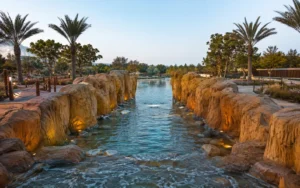
Another highlight of the outdoors is the Prophet Moses Miracle Lake. The lake is an interpretation of the miracle of the Prophet Moses, which is the splitting of the sea to let his people go out of the way of their enemies, according to Dubai Municipality.
Consider it a landscape interpretation rather than a recreation swimming or boating site. It is to be a component of the wider presentation of Quranic stories through the physical environment in the park.
Solar Trees and Sustainable Design
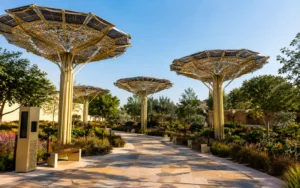
The park’s infrastructure is designed to promote sustainability. The unique solar trees are said to be inspired by Islamic art and geometric designs, according to Dubai Municipality. They produce solar power for the lighting and phone-charging stations, and the walkways in the park are lighted with an off-grid solar lighting system.
The features are especially relevant in that they tie into the culture of the park and modern environmental technology, rather than sustainability being an add-on.
Children’s Play Areas
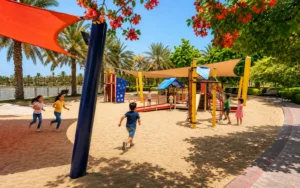
There are dedicated facilities for recreational use within the park for families with young children. According to Dubai Municipality, there are two children’s play areas for children aged 2- 12 years old.
This is far more useful for families that want to spend longer at the attraction. The orchards and other areas of the park are open for adults to explore while the children take advantage of the play areas.
Quranic Park Dubai Ticket Price
| Attraction | Ticket Price | Priority |
| General Park | Free | Essential |
| Glass House | AED 5 | Recommended |
| Cave of Miracles | AED 5 | Recommended |
| Glass House + Cave of Miracles | AED 10 | Best Value |
| Children Under 3 | Free | — |
| People of Determination + 2 Companions | Free | — |
Current 2026 visitor information reports AED 5 for each paid attraction, while Dubai Government legislation establishes AED 10 for the two attractions together.
Opening Hours and Seasonal Timings
The timings of Quranic Park may vary during the season of Ramadan, public holidays, and other festive seasons. The park was open during Ramadan 2026 from 9:00 AM to 12:00 AM, and the Glass House and Cave of Miracles were open from 1:00 PM to 9:30 PM.
Other sources of visitors give different regular hours, so I cannot guarantee a set hour for all days in August 2026. Please refer to the latest timings before visiting, particularly the Glass House and Cave of Miracles.
Read Also: Souq Extra Silicon Oasis
How to Reach Quranic Park Dubai
The park is situated in Al Khawaneej, and is best accessed by car or taxi. The public transport option is also available, but there’s no Dubai Metro station directly at the park.
By Car
Car is one of the most convenient means, particularly for families. The park offers parking, making it convenient for those who drive.
By Taxi
The direct path is through taxis and ride-hailing services. Just type in Al Khawaneej as the destination in Quranic Park.
By Metro and Public Transport
The park does not have a metro station. People from abroad or travelling by public transport must book a bus or taxi along with a Metro ticket. Please refer to the RTA journey planner for current journey details before travelling, as journeys and timings may vary.
Quranic Park Dubai Timings
| Area | Timing | Status |
| Quranic Park | 8:00 AM–10:00 PM | Previously published schedule |
| Glass House | 9:00 AM–8:30 PM | Separate entry hours |
| Cave of Miracles | 9:00 AM–8:30 PM | Separate entry hours |
| August 2026 Schedule | Not confirmed | Check before visiting |
The above timings have been officially published by Dubai Municipality for a 2024 Eid Al Adha holiday schedule, but should not be considered a fixed daily schedule for August 2026.
Note: I can’t confirm the exact timings from an official source from Dubai Municipality in August 2026; please check before traveling.
What Is the Best Time to Visit?
As a rule, it is a more pleasant time of day for an outdoor experience, early morning or late afternoon. This is especially true in summer when there is much to inspect outdoors in orchards and landscape areas.
There are also shaded seating areas along the walking routes in the park, which can make it easier for families to visit later. Dubai Municipality has specifically developed shaded spaces close to the walkways as part of the project.
In case your primary mission is actually the indoor attractions, arrange about their individual admission and hours of operation, instead of simply turning up when the outdoor park opens.
Accessibility and Family Facilities
Accessibility is a strength of the attraction. Dubai Municipality announced that Quranic Park has been given Certified Autism Center™ status in 2025, after a training session for its staff, and assessments and enhancements of the facility to accommodate visitors with autism and sensory sensitivities.
The increased accessibility also features better signage, a sensory-friendly zone, a quiet room, better restroom facilities, and wheelchair-friendly pathways and ramps.
The Quranic Park is also recognized by Dubai Municipality as one of the public parks that have been adapted to meet accessibility demands, such as pathways for the handicapped, braille signage, adapted play equipment, and handicapped parking.
This makes this a better park than many other outdoor attractions for families with different accessibility requirements.
Is Quranic Park Suitable for Children?
Yes. The park was created for families spending time, with two children’s play areas for children ages 2-12.
The “children’s facilities” are helpful in cases where children might not want to spend the entire trip on plant information and the indoor exhibits. Families can then engage in educational experiences while enjoying outdoor activities.
Enhanced accessibility of the Park has also been rolled out to the children’s facilities, with Dubai Municipality confirming that children’s play areas have been qualified to cater for People of Determination.
How Long Should You Spend at the Park?
If you’re aiming for the highlights, then a 2-3 hour visit is a good estimate of how long it will take you to plan.
A shorter visit may suffice if you are only interested in walking through the gardens and views of the main outdoor features. However, families might require more time due to the play areas, walking distances and time spent inside the Glass House and Cave of Miracles.
A practical order is one that:
- Begin in the orchards that are outside.
- Pay a visit to the Glass House.
- Hike to the Cave of Miracles.
- Visit the site of the Prophecy of Moses Miracle Lake.
- Allow children time at the play areas.
- Complete with the shaded outdoor spaces.
Depending on your pace and if you don your droids in both attractions, the exact time is going to vary.
What Should You Bring?
It is a walkable outing- due to a lot of the experience being outside. Shoes that can be worn in the comfort of the home are more useful than those that can only be worn inside.
Sensible, also, is water and sun protection, especially in warmer weather. When travelling with kids, packing the necessary gear for a few hours outdoors can make it a much easier experience.
A weather forecast is also a good idea to check before heading out, as much of the park is outdoors.
Why the Park Is More Than a Tourist Attraction
The educational and inclusive public open spaces are one of the less apparent assets of the park.
The project’s original concept was to be explicit and centered around the Quran and Sunnah, with the plants, orchards, and interactive exhibits conveying cultural and educational information.
This idea has been carried over to the newer accessibility programs of the park. The 2025 Certified Autism Center recognition is not just about the landscape; it’s about making the visitor experience accessible to more families.
The park is also a community space. A few examples are Dubai Municipality’s 2025-26 Farmers’ Market season, which took place at the Quranic Park, and Visit Dubai’s Al Khawaneej events and activities, which have included the park.
Nearby Places to Visit After Quranic Park
The Al Khawaneej area allows for a park to be integrated into other leisure activities, such as car travel. Visitors are not intended to see the museum as an end in itself, but may construct a half-day itinerary which includes additional food, shopping and outdoor activities nearby.
Last Exit Al Khawaneej
After visiting the park, food can be found at Last Exit Al Khawaneej. According to Visit Dubai, Last Exit is a gourmet food-truck spot, offering a variety of food and beverages to visitors.
This is a great idea for families, since the park takes care of the outdoor and educational component of the outing, and Last Exit provides a casual location to eat once you’re done.
Al Khawaneej Walk
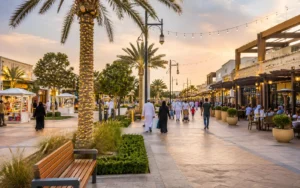
Another local fun activity is Al Khawaneej Walk, where you can indulge in outdoor shopping and dining. According to Visit Dubai, it is a destination that’s community-oriented with retail, food, and leisure experiences.
If you’re looking to extend your party after a visit to the park but not quite back to central Dubai, it can be included in your tour package.
Mushrif National Park
There are other large green spaces in the broader region, such as Mushrif National Park. According to Visit Dubai, it is a “large recreational destination with a wide array of facilities.
The linkage between the two destinations is also pertinent to cyclists. The Dubai official cycling map shows the 19-kilometre Khawaneej Track, which is part of the Al Khawaneej community and linked to the Mushrif Park track.
This will be a handy option for tourists who ride bikes instead of taking the bus tour.
Is Quranic Park Worth Visiting?
Yes, especially if you’re interested in Islamic history, gardens, family attractions, educational sites and more relaxed outdoor pursuits.
More of it’s the features, more than any one. The park is a collection of Quranic plant orchards, botanical displays, interactive exhibits, sustainable infrastructure and family facilities in a single large public space. The information currently available about the project in Dubai Municipality confirms the scale of the project as 64 hectares, and the combination of an orchard and a Glass House and a Cave of Miracles, a lake, and recreation facilities.
Additionally, it is unlike severalof Dubai’s main attractions. The primary reason for visitors’ visits is not a view from the top of the tallest structure, shopping, or high-stress activity. The attraction’s focus is on nature, learning, and cultural interpretation.
Another big benefit is the access. Dubai Municipality confirmed that the park has been awarded Certified Autism Center™ status in October 2025. The upgrades comprised staff training, signage to enhance accessibility, sensory-friendly spaces, quiet rooms, facilities, and wheelchair-friendly pathways and ramps, the municipality said. This is a great choice for families looking for an outdoor spot they can all enjoy together.
Tips for a Better Visit
Some simple tips can help make it easier.
Please read the hours of the attraction individually. The outdoor parks and the Glass House/Cave of Miracles are not guaranteed to be open at the same times. Park hours have changed for Ramadan and public holidays in the past, and an article that is older than today should not be considered as a confirmation of the hours today.
Think outside the box for walking outside. Lots of outdoor main features and a large site. Wearing comfortable shoes, water, and sun protection will be helpful, particularly in the warmer months.
Please give sufficient time for both paid attractions. If you want to see the educational aspect of the park, then the outdoor orchards are all you’ll see, which is a pity because you won’t see the Glass House or Cave of Miracles.
Go out before or after the heat of the day. This decreases the time of outdoor walking during peak heat.
Look for seasonal activities. Community activities are also offered in the park. Dubai Municipality’s 5th Farmers’ Market Season, for instance, was held at the park in the winter season of 2025 – 26, and Visit Dubai has held events at the park.
Final Thoughts
Quranic Park Dubai is a unique blend of nature, Islamic heritage, education and family recreation. In addition to its 64ha of area, themed orchards, Quranic plant collection, Glass House and Cave of Miracles, this park offers visitors a lot more to explore than a typical neighbourhood park.
The attraction is ideal for families and those interested in learning and culture over Dubai’s more commercial offerings. The recent accessibility enhancements and Certified Autism Center™ status further solidify its status as an inclusive public venue.
To enjoy, make an outdoor park trip separate from the paid attraction visit (which may occur at different hours), and take several hours to visit, and check the current official information before traveling as seasonal and holiday schedules change.
Read Also: Khalifa Park Abu Dhabi: Attractions, Timings & Ticket Details
Al Barsha Pond Park: Complete Visitor Guide, Activities, Facilities & Timings
Secret Beach Dubai: Location, Entry Fee, Best Time & Visitor Guide
Frequently Asked Questions
Is Quranic Park free to enter?
Yes. The grounds of the park are open to the public; the Glass House and Cave of Miracles are admission-charged attractions. Official Dubai law has set an entry fee for the two attractions.
How many Quranic plants are in the park?
Today, Dubai Municipality claims that there are 51 species of plants mentioned in the Holy Quran throughout the park’s themed orchards and displays.
Where is the park located?
It’s situated in Al Khawaneej, Dubai. There are also links to other leisure facilities such as Last Exit Al Khawaneej and Al Khawaneej Walk.
Is the park suitable for children?
Yes. Dubai Municipality has two children’s play areas for children between the ages of 2 – 12. The park has also made improvements to make facilities more accessible/inclusive.
How long does it take to visit?
For a tour of the main outdoor spaces, plus sightseeing of the two large indoor attractions, two or three hours is about the time you should allow. Depending on the amount of time children spend in the play areas, families may require more time.
Is there a Metro station at the park?
There are no nearby Metro stations to the attraction. People taking public transportation usually will have to go by Metro and then take another mode of transport. Which route is best depends on where you are, so it’s best to consult the RTA journey planner to see what’s available at the time of travel rather than take a bus or Metro map that may be outdated.
What are the main attractions?
The main attractions include the 12 themed orchards, Glass House, Cave of Miracles, Prophet Moses Miracle Lake, solar trees and shaded areas, and children’s play areas.