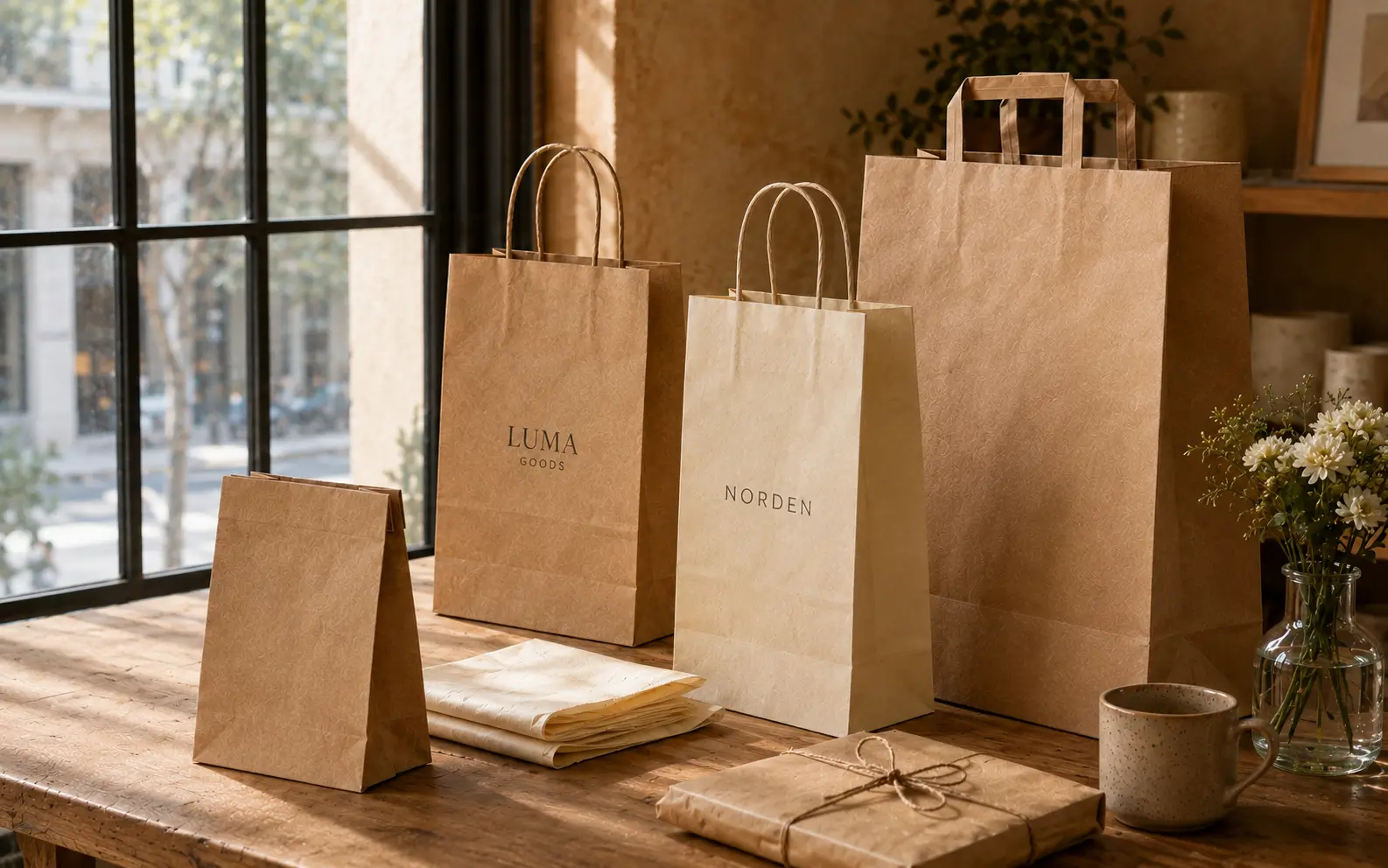
A paper bag looks like the simplest thing a business buys. In practice, “a paper bag” is a dozen different objects — different handles, different body shapes, different proportions — and the wrong combination announces itself quickly: handles that tear on the second use, a bag that slumps because it has no base, or a premium product handed over in something that quietly cheapens it. Choosing well is mostly a matter of matching the style and size to what the bag is actually carrying.
This is a working guide to the choices that matter, and how to make them.
Handles come first
The handle is the first thing a customer touches and the first thing to fail, so it is the right place to start.
Flat paper handles
Folded flat paper strips, glued inside the bag. They are cheaper than twisted handles and run faster on automated lines, which is why paper bags with flat handles — the kind produced at scale by manufacturers such as VITA GROUP — dominate takeaway and high-volume everyday retail. The trade-off is comfort under heavier loads: a flat handle bites into the hand sooner than a twisted one, so they suit lighter or short-carry use.
Twisted paper handles
Made from twisted kraft paper glued inside, these are the dependable all-rounder. Comfortable to hold, good for medium loads, fully paper, and still machine-applied at volume. For most boutique and mid-market retail, this is the default that rarely disappoints.
Die-cut handles
A handle hole punched directly into the bag wall, usually with a small reinforcing patch behind it. The most economical option and a clean, minimal look — but it relies on the paper weight for strength, so it suits lightweight retail and promotional bags rather than anything with real load.
Rope and cord handles
Cord handles fixed through eyelets — the signature of rigid and laminated luxury bags. They feel substantial, allow a longer drop for shoulder carry, and read as premium, at a higher cost and slower production since they are often hand-finished. Reserve them for where presentation justifies the price.
Body style: whether the bag stands and holds
How the bag is built decides whether it stands upright, how much it holds, and how quickly it fills.
SOS (self-opening) bags
A flat, square base lets the bag stand and, crucially, snap open on its own. That self-opening action is the difference between filling a bag one-handed in seconds at a busy counter and fighting a flat pouch. SOS bags suit takeaway, bakery and grocery, with or without handles.
Gusseted bags
Gussets are the folded panels that expand to add volume — side gussets widen the bag for bulky items, a bottom gusset lets it stand and carry more. This is the lever to reach for when contents are deeper or heavier than a flat bag can take.
Block-bottom carriers
The rectangular-based carrier that stands upright and presents boxes, bottles and folded goods neatly — the retail shopping-bag standard, and the natural choice for fashion and gift retail.
Flat (pouch) bags
A single flat profile with no gusset — the cheapest, lowest-volume option, right for slim items like documents, prints or bakery flats and wrong for anything that needs to stand or hold bulk.
Matching the style to the product
Start from the contents and the choice usually answers itself:
- Fashion and boutique retail → block-bottom carrier with twisted handles; rope handles for luxury.
- Takeaway and packed food → SOS with flat handles, chosen for speed and stand-up filling.
- Bakery and bread → SOS or flat bags, often with a display window.
- Groceries → large SOS or gusseted carriers with reinforced bases.
- Bottles and wine → narrow gusseted or partitioned bags with a strengthened base.
- Gifts and premium goods → rigid or laminated rope-handle carriers.
- Promotional and giveaway → die-cut-handle flat bags, where unit cost leads.
Sizing: the part most briefs skip
With the style chosen, size is where good intentions quietly come undone. A bag is three numbers, not one — width × gusset (depth) × height — plus the handle drop. Brief all four, because “a medium bag” means nothing across two suppliers.
Size to the product, not to the logo. A bag that is too large lets the contents slide and tip and makes even a good product look cheap; one that is too small splits at the seam or strains the handles. The gusset is the volume lever: widen it for boxed or bulky goods rather than reaching for a taller bag that still tips over. Handle drop is a use decision — a short drop for hand carry, a longer one where customers carry on the shoulder.
One thing worth remembering: a bag’s safe load is not set by paper weight alone. The GSM, the handle type and the base construction work together — a heavy paper with a weak die-cut handle still fails at the handle. And rather than a bespoke size for every product, standardising to a small range — small, medium, large — that covers most of your line keeps minimums lower, reorders faster and stock simpler, with very little compromise in fit.
A quick decision guide
- Carries weight, must look considered → block-bottom carrier, twisted handles.
- Filled fast at a counter → SOS, flat handles.
- Bulky or deep contents → generous side and bottom gussets.
- Premium presentation → rigid or laminated body, rope handles, longer drop.
- Light and cost-led → flat bag, die-cut handles.
A note for the UAE
Two local factors are worth weighing. The climate is one: heat, humidity and the condensation that forms when a bag moves between air-conditioned and outdoor spaces put real pressure on handles and paper, so it is worth erring toward sturdier construction than a temperate market would need. The other is the region’s strong gifting and premium-retail culture, which pushes a large share of bags toward the considered end — block-bottom carriers, rope handles, heavier stocks — where presentation carries social and commercial weight.
Specify the style for the job, the construction for the load, and the size to the product — in that order — and the bag does its work without ever drawing attention to itself. Which, for packaging, is exactly the point.
Read Also: Dubai Creek Tower