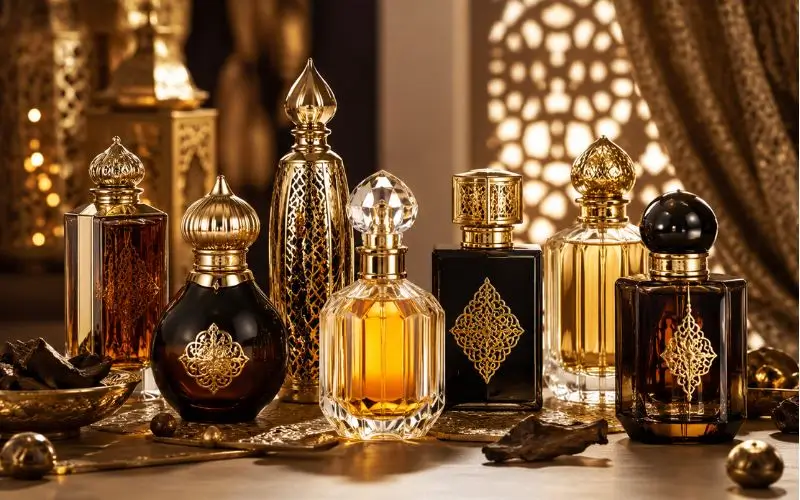
Suddenly, you got a whiff of something amazing on somebody, and you felt like I want this in my life! Welcome to the beginning of an Arabic perfume collection.
In case you’re searching for the guide “How to start an Arabic perfume collection without panicking,” then you are in the right place. This guide explains all of this and how to find out about fragrance families and select your first fragrance bottles with confidence.
What Makes Arabic Perfumery So Different?
Perfumes in Arabic have been elegantly intertwined with a philosophy different from the Western one for centuries. Western perfumery aims at lightness and timeliness, Arabian sensibility at richness and duration, and the changing of perfumes as it moves. The base notes are dominated by oud,amber, musk, and sandalwood, which are thick, resinous granules that stick to the skin to persevere.
The result is a long-lasting and authentic Arabic perfume. Even a good Arabic EDP should be apparent eight hours after application and usually even longer.
Step 1: Start With One Fragrance Family
Know what it is that you’re attracted to before you start exploring everything. The Arabic perfumery industry has four main sub-groups:
Floral Orientals: rose, jasmine and orange blossom fanned out over warm bases. Perfect for novice collectors who want to indulge in something instantly stunning.
Woody Orientals: sandalwood, cedarwood and vetiver in grounded, sskin-closefragrances.
Oud-forward: the end of Arabic perfumes that is the deepest and most resinous. The ultimate Arab Oud perfume.
Gourmand Orientals: vanilla, amber and sweet flavors, layered over warm bases. More convenient to wear every day.
For newbies, begin with a floral or gourmand. Both are convenient starting points for a novice in perfumes in Arabic.
Step 2: Quality, Not Quantity, is the way to go
Among the most frequent errors while getting started on building a perfume collection is to buy too many bottles too quickly. Three to five good bottles will make you happier than fifteen mediocre ones.
Find niche Arabic perfume houses that use good quality ingredients and not mass market synthetics.
Step 3: Build a Day, Evening and Occasion Rotation
Having options is not the only thing a well-thought-out luxury fragrance collection is. It’s all about carrying the right perfume for any occasion.
Expect to use 3 scents: one for the day, one for the evening or special occasions, and one for everyday use because it’s “the best”. For the daytime, try fresh florals or citrus-led Orientals. Go for oud and amber for nights. When it comes to a signature scent, opt for one which is almost like a second skin.
Royal Rose; rose attar with a hint of jasmine and musk, clean and softly elegant, is a good choice for romance and florals.
Step 4: How to Layer
Layering is a part of the ritual of Arabic perfumery. Scented oil will be added first, and then the Eau de Parfum will be spritzed on top, resulting in a dimension and longevity that your single-layer application will never be able to provide. This is a change for anyone who takes the perfume world seriously and wants to create a collection of Arabic perfumes.
Step 5: Give Each Fragrance Time
Oriental fragrances evolve. What you smell in the first 30 seconds is not what you will smell in 2 hours. No doubt wearing a perfume for a full day before the judgment should be made whether it is worth adding to your collection or not. The top notes are simply the first notes. The base is the commitment.
We hope this will be of service to you and will help you with the realization of your very own luxury Arabic Perfume Collection.
RESEARCH SOURCES
- Turin, L. & Sanchez, T. (2008). Perfumes: The Guide. Profile Books.
- Aftel, M. (2001). The Natural History of Perfume: Essence and Alchemy. North Point Press.
- Fragrantica — Arabic and Oriental fragrance family classifications. fragrantica.com
- Zillion — A review site for perfumes. zillion.com
- Al-Hassan, A.Y. & Hill, D.R. (1986). Islamic Technology. Cambridge University Press. [Arabic perfumery history]
Read Also: Al Hamriyah Public Beach