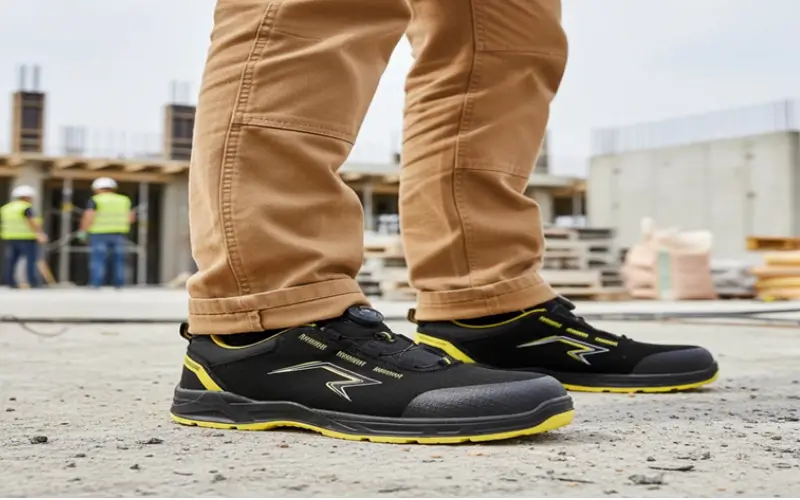
One of the most common problems on construction sites and in warehouses across the UAE is the purchase of safety shoes for workers in the same size as their everyday trainers. Within just a few weeks, workers experience pressure on their toes, swelling, pain in the instep, and rapid fatigue. In hot climates, the situation is exacerbated: the foot swells and increases in volume by the end of the shift. The correct size of safety shoes is determined not only by the length of the insole, but by the overall fit of the shoe. This takes into account the width of the foot, the height of the instep, the anatomy of the toes, and the space required for the foot to move naturally under load.
Why do safety shoes need to be a size larger?
The main difference between safety shoes and ordinary shoes is the presence of a protective toe cap. Steel or composite toe caps do not stretch over time, unlike ordinary trainers. If the shoes feel tight when you first try them on, this will not change once they have been broken in. In the UAE, it is best to try on shoes in the afternoon. After just six hours of work, your feet naturally swell, especially in high temperatures and after walking on concrete for long periods.
Another important point is toe cap clearance. There should be a gap of around 0.5–1 cm between your toes and the toe cap. This gap isn’t needed to allow for growth, but to ensure proper biomechanics when walking.
How to tell if you’ve chosen the right size of safety shoes
Properly fitted safety footwear should securely support the foot without putting pressure on the toes, the instep, or the sides while walking:
- Your toes should be able to move freely inside the shoes. The toe box should not squeeze your toes when walking or squatting.
- The heel doesn’t slip when walking. The secure fit prevents chafing and reduces the risk of losing your balance.
- The arch support fits snugly without feeling tight. The shoes should support the foot without causing numbness or a feeling of pressure on top.
- The foot does not squeeze at the sides whilst walking. The correct width helps to prevent pressure on the little toe and big toe during prolonged use.
If even one part of the shoe feels uncomfortable when you try it on, the problem will only get worse after 10–12 hours of wear. When you want to buy safety shoes in the UAE for a construction site, warehouse or industrial facility, it is important to check the fit of the shoes under real-world conditions, rather than relying solely on the size label.
Why does the arch support in safety footwear affect a worker’s comfort?
Even shoes of the correct length can cause pain if the arch support is unsuitable. People with high arches are more likely to experience pressure on the top of the foot, whilst those with flat feet may find their shoes slip around on the foot, increasing the risk of chafing and sprains. This is particularly noticeable when working for long periods on ladders, metal structures and uneven surfaces.
What helps to adapt shoes to the shape of the foot
The comfortable fit of safety footwear is achieved through a combination of design features that work together to ensure the foot is properly supported:
- The adjustable lacing allows you to adjust the fit.
- The soft tongue reduces pressure on the instep.
- An anatomical insole provides better heel support.
- Proper inflation prevents side compression.
Safety footwear for high insteps should be selected individually rather than based on standard sizes.
Checklist for the perfect fit in safety footwear
Before buying safety footwear, it is important to check several key areas, as these directly affect comfort and safety whilst on the job.
| Checkpoint | As it should be | Sign of a mismatch |
| Toes | They move freely inside | They rest against the footboard |
| Heel | Securely fastened | Slips when walking |
| Rise | The shoes fit snugly without feeling tight | Numbness or poor grip |
| Width | Your foot doesn’t slip off | Pressure on the little finger or thumb |
How to order safety shoes online without trying it on
It is best to measure your foot in the evening before placing an order. Place your foot on a sheet of paper, mark the edge of your heel and the tip of your longest toe, then measure the distance in millimetres. It is important to take into account the type of socks you will be wearing. Thin sports socks and thick work socks result in a completely different fit inside the shoe.
Equally important is the size chart used by TALAN or any other specific manufacturer. A Chinese size 42 and a European size 42 can differ by several millimetres, and in safety footwear, that is enough to cause constant discomfort.
Why proper posture is more important than looking good
Even the most technologically advanced shoes won’t be comfortable if you choose the wrong size. By spending 10 minutes measuring your feet and checking the width, you can avoid months of pain, blisters and chronic foot fatigue.
TALAN models are designed with the anatomy of the foot in mind and for long hours of work in hot climates. Through Verona Shoes FZE in the UAE, models in a range of widths are available, along with expert advice on sizing for construction, logistics and manufacturing sites.
You Also like:
Al Habtoor Business Tower Dubai
Gold Souk Sharjah