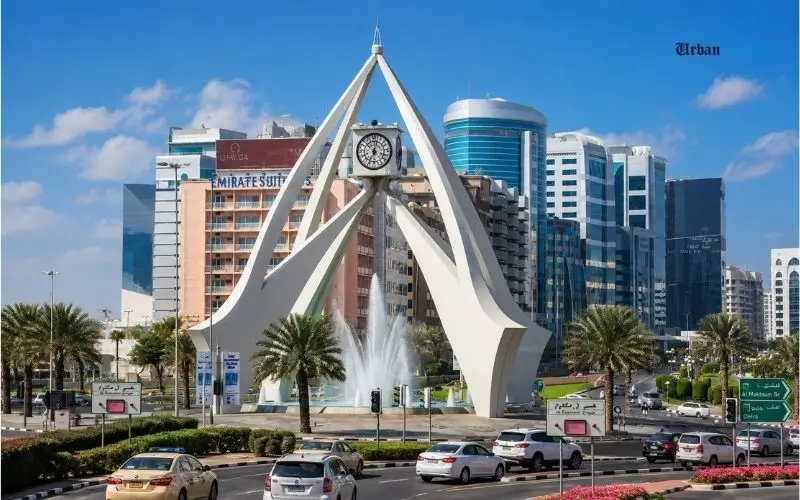
While there are plenty of iconic landmarks in Dubai, some of them have a more profound connection to the city’s history. Deira Clock Tower is an iconic landmark in the heart of Deira, close to Al Maktoum Bridge. It was constructed during Dubai’s early stages of modernity and became a significant urban sign. It has a simple yet recognizable design with its distinctive arches and four-sided clock. The landmark also showcases Dubai’s architectural past from the 1960s and the development of Deira as a significant commercial hub. It is still a great place to begin exploring Dubai Creek, the traditional souks, and Old Dubai today.
Quick Facts About Deira Clock Tower
| Detail | Information |
| Location | Deira, Dubai, United Arab Emirates |
| Main road | Al Maktoum Street |
| Nearby landmark | Al Maktoum Bridge |
| Construction | Dubai Municipality records it as 1963 |
| Architectural period | 1960s modernism / regional modernism |
| Original purpose | Public clock and major urban landmark |
| Structure | Four clock faces supported by curved arches |
| Major restoration | Roundabout and surroundings upgraded in 2023 |
| Nearest Dubai Metro options | Deira City Centre and Al Rigga on the Red Line |
| Area character | Historic Deira, Dubai Creek and traditional markets |
Note: The exact year is not agreed upon by historians. Dubai Municipality dates it to 1963, and the UAE Ministry of Culture’s heritage record was 1968. In this guide, the official date of 1963 is used for the original construction, as determined by Dubai Municipality.
Where Is Deira Clock Tower?
The landmark is situated in Deira, which is one of Dubai’s oldest urban Districts. It is located at the main road junction of Al Maktoum Street and Al Maktoum Bridge (also called Al Bawwani), which crosses over DubaiCreekk, connecting Deira and Bur Dubai. The intersection is considered by the Dubai Municipality as an important intersection involving Umm Hurair Street and Al Maktoum Street.
The site is significant to its history. Deira was an important commercial hub in the early modernisation of Dubai, and the bridge became an important link between the two banks of the creek. The tower thus evolved into a decorative building. It was a public landmark in the city.
According to the official tourism website of Dubai, it is a historical monument in Deira, connecting to Al Maktoum Bridge.
The neighbouring area is also great for tourists looking to explore another Dubai experience. The markets and creekside environment and commercial history are recognized as the hallmark of Deira. Visit Dubai says the neighbourhood has a rich history and traditional souks.
History of Deira Clock Tower
How the idea started
The tower’s history started before it was built, with a clock.
The large clock was gifted to Sheikh Rashid bin Saeed Al Maktoum, former Ruler of Dubai, by his son-in-law, Sheikh Ahmad Al Thani, Ruler of Qatar, according to the historical account published by The National. Eventually, the concept of a public sculpture around the clock was born thanks to the gift.
According to the UAE Ministry of Culture, the tower was originally erected as a clock, which was gifted to Sheikh Rashid, and the architects created the landmark around it.
This detail is the reason for the form of this building. It was not intended as a traditional memorial piece, which was to be richly adorned. Rather, the buildings were designed to serve the purpose of an object to be displayed.
Why was it built in Deira?
The decision was made to choose Deira as the district, and it was because of its significance at the time.
Deira was one of the most hectic areas of Dubai in the 60s. Being close to Al Maktoum Bridge put the tower in an important location between Deira and Bur Dubai. The architectural history also records that passengers on boats coming in from DubaiCreekk or by air at the growing Dubai Airport might have found themselves face to face with the landmark as they entered Dubai.
Dubai Municipality says that the tower came to be connected with the first land crossing between Deira and Bur Dubai, and was one of the emirate’s key population hubs.
This was particularly useful in making the tower a city marker. Before the rise of skyscrapers in Dubai, such structures played a crucial role in helping people navigate and orient themselves.
When was it built?
It is noted that there are differences in the construction date between the sources.
The tower is recorded by Dubai Municipality as built in 1963, and the official restoration material dates it as built in that year.
The UAE Ministry of Culture’s heritage page, however, has the date of construction as 1968.
The National reports that it was officially completed in 1965.
These dates overlap in time, so it is inaccurate to claim one date as “the” date of the invention. The best current municipal record is for 1963, which is the date used for this article.
Architecture and Design
The architecture is one of the reasons why the tower is still recognizable for decades.
The UAE Ministry of Culture says the design is a simple form that doesn’t include any of the traditional elements of ornamentation. Four arched elements act as supports and come together at the clock on top. The open lower part permits traffic and views to flow through.
This is a key characteristic as the tower was located in a traffic roundabout. A solid monument could have cut off views and hindered movement around the junction. The open arches worked perfectly as a practical solution and yet formed an excellent visual landmark.
Read Also: ACICO Business Park
Who designed the tower?
The heritage record from the UAE Ministry of Culture credits the concept sketch to Otto Bulard and the design to Zaki Al Homsi, who also played a part in building the tower via Architecture Design Construction.
Historical reporting also attributes the final design and construction to the Syrian architect.
The outcome is a modernist building with regional style. The wide arches lend the building a unique shape, while expelling the superfluous ornamentation.
The Ministry of Culture refers to the landmark as an example of regional modernism and modernism. The space within its structure also exemplifies form following function as it ensures visibility and maintenance of movement around the roundabout.
Why the Landmark Is Important to Dubai
The importance of the tower goes beyond its appearance.
During the first few decades of modern Dubai, the city was expanding around Dubai Creek, trade routes, and new road connections. The tower was located at one of these strategic locations and was noted on both sides of the creek.
It indicated to the travellers that they were crossing the creek and entering Deira, according to the UAE Ministry of Culture. It also linked key urban features, such as Al Maktoum Bridge, Dubai Municipality and the port.
This makes the landmark different than newer attractions. It is an era in which Deira was the hub of business and urbanization in Dubai.
Dubai Municipality has continued to designate the Clock Tower as one of the modern heritage sites in Dubai. The authority’s modern heritage programme puts the Clock Tower in the architectural heritage of Dubai in the 1960s.
In 2025, Dubai Municipality also featured the Clock Tower as part of the World Heritage landmarks promoted during the Dubai Municipality’s celebrations of World Heritage Day.
Restoration and Renovation
The building has evolved over the years.
According to historical reporting, deterioration of the original concrete construction is observed, such as corrosion due to the materials used in the early construction period. The tower was then rebuilt and restored.
In parallel, the local road network also evolved with Dubai’s development. It is claimed that the tower was relocated several metres to make way for a new underpass when traffic grew.
2023 roundabout restoration
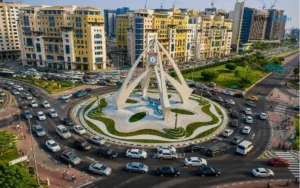
The roundabout and public space around the roundabout have been upgraded more recently.
Dubai Municipality announced the restoration project in May 2023. This work consisted of adding new hard flooring, new landscaping, multicoloured lighting and enhancements to the water fountain. The authority has said that the old building will stay intact while the rest of the area will be modernised.
Later, Dubai Municipality said the project was a “significant restoration for the tower and its environment and is part of the measures taken to protect Dubai’s heritage and enhance urban spaces”.
An important part of this was the way this project did not seek to replace the landmark with a modern building. Rather, it was about keeping the historic character and enhancing the public space that surrounds it.
Read Also: Emaar Boulevard Plaza
How to Reach Deira Clock Tower
Dubai Metro, taxi, or road transport is the best method of getting to the area.
There is no dedicated Metro station for the tower. There are, however, two Red Line stations in the broader Deira area – Deira City Centre (R16) and Al Rigga (R17). Both stations are currently on the RTA metro map (which is the Red Line).
The Clock Tower and Al Maktoum Street and nearby pedestrian/bus facilities are also clearly indicated on the map of the Deira City Centre area, developed by RTA.
By Dubai Metro
If you are travelling on the Red Line, the stations of interest are Deira City Centre and Al Rigga. It will depend on the actual starting point and the option of walking or taking a taxi to get to the station.
The key here is that the tower isn’t directly by a designated rail station access as opposed to being within the existing road network in Deira.
By road
The landmark is located around a big road junction close to Al Maktoum Bridge. According to Dubai Municipality, Umm Hurair Street and Al Maktoum Street are part of the junction.
The tower is situated in a busy traffic area, so visitors need to use the roundabout as a road landmark, and not as a pedestrian destination that they can stroll across the roadway.
What to See Near the Tower
The tower is one of the best reasons for visiting this area of Dubai because it can be used in conjunction with some of the attractions in Old Dubai.
Dubai Creek
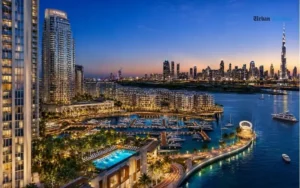
Dubai Creek is at the heart of Deira’s history. The creek was the site of maritime commerce, and it helped to influence the development of the districts on either side of the creek. According to Visit Dubai, Deira Creekside is the location where one can learn about the origins of Dubai, the trading city by sea, and the traditional souks.
It is therefore possible to visit the tower, and then have a creekside walk or a traditional abra ride.
Spice Souk
Another natural addition to a Deira itinerary is the Spice Souk. Dubai market is a traditional bazaar with spices, herbs, teas, nuts, oils and saffron, according to Visit Dubai.
The souk also offers a far more immersive adventure than just taking a photo of a landmark, as visitors can discover the business heritage of Old Dubai.
Gold Souk
Another big attraction of Deira is the Gold Souk. According to Visit Dubai, it is one of the traditional markets of Dubai for gold jewellery and gemstones.
The combination of the tower and the traditional markets of Deira would provide a more comprehensive historical visit due to the shared wider district and commercial heritage.
Al Maktoum Bridge
The bridge is a part of the tower’s story. The Clock Tower is part of Dubai Municipality’s Historic Link between Deira and Bur Dubai.
The combination of the bridge and the tower, together, helps to understand why the bridge/tower junction became so significant during the early stages of Dubai’s road network expansion.
Is Deira Clock Tower Worth Visiting?
I would say yes, especially for tourists who are interested in the history of Dubai as well as architecture and Old Dubai.
It is not a “must-see” at a theme park or a standard lookout. The value is due to its historical context, unique modernist architecture, and its location in one of Dubai’s oldest commercial areas.
A short stop can be included in a larger Deira trip, and isn’t necessarily a half-day attraction on its own. The neighbourhood features natural access to the creek and to the historic areas of the city, as well as traditional markets.
The arches and clock face are curved and have four sides to it, which makes it an identifiable architectural element to the photographer. The landmark is particularly significant to those interested in history, as it serves as a tangible reminder of the Dubai that has changed over the years, and the growth of road connections between Deira and Bur Dubai.
Best Time to Visit
The outdoor landmark onthe Dubai tourism page does not have an official visitor timetable, so it is best to consider the timing according to comfort and surrounding activities.
The cooler times of day are usually more convenient for trips to wider areas of Deira, particularly if walking around outside markets and along the creek is part of the trip.
Seeing an evening performance can give a different visual feel, as the surrounding urban population is more active at night. Visitors should look out for safe footpaths around the noisy roads and roundabout, however.
Conclusion
Deira Clock Tower continues to be a significant landmark of the early modern development of Dubai and Deira, a significant commercial center. It has heritage value as it is original to the 1960s, is part of a regional modernist architectural movement, is associated with Al Maktoum Bridge, and for its unique clock design. The surrounding roundabout has also been restored, helping to maintain its presence in Dubai’s ever-evolving urban landscape. The landmark is most effectively enjoyed by a visitor on an Old Dubai tour, along with Dubai Creek, the historic streets of Deira, Al Maktoum Bridge, and the traditional souks. These sites provide a window into the evolution of Dubai from a creekside trading centre to the city it is today.
Read Also: Clock Tower Roundabout Dubai History, Location, Facts & Attractions
Abra Deira Dubai: Routes, Timings, Fare & Visitor Information
Al Rigga Metro Station: Route, Timings, Fares & Nearby Attractions
Frequently Asked Questions
What is Deira Clock Tower famous for?
Deira Clock Tower is well known for its unique 1960s style and association with the development of Deira as an important commercial hub. It was close to Al Maktoum Bridge, too, making it a familiar landmark in Dubai.
When was Deira Clock Tower built?
Dubai Municipality states that the tower was built in 1963. Some other historical sources, however, provide other dates, and 1963 is best considered as the Dubai Municipality date.
Who designed the clock tower?
The UAE Ministry of Culture credits the idea sketch to Otto Bulard and the design and realization of the landmark to Ziki Homsi.
Why is Deira Clock Tower important?
The tower is significant not only in terms of its importance in Dubai’s modern architectural heritage, but also in terms of the unprecedented development of Deira in the 1960s. It also signifies the high possibility of a road link between Deira and Bur Dubai.
Is Deira Clock Tower near Dubai Creek?
Yes. The landmark is in Deira close to Dubai Creek and Al Maktoum Bridge, making it easy to combine with other Old Dubai attractions.
What can I see near the clock tower?
The Dubai Creek, Gold Souk, Spice Souk, Al Maktoum Bridge, and other historic places of Deira are for visitors to explore. These attractions can be incorporated in an extended Dubai old city tour.
Can tourists visit the clock tower?
Yes. The clock tower is an outdoor landmark that can be seen from the public areas around it. The landmark does not have any separate entrance or museum admission listed.