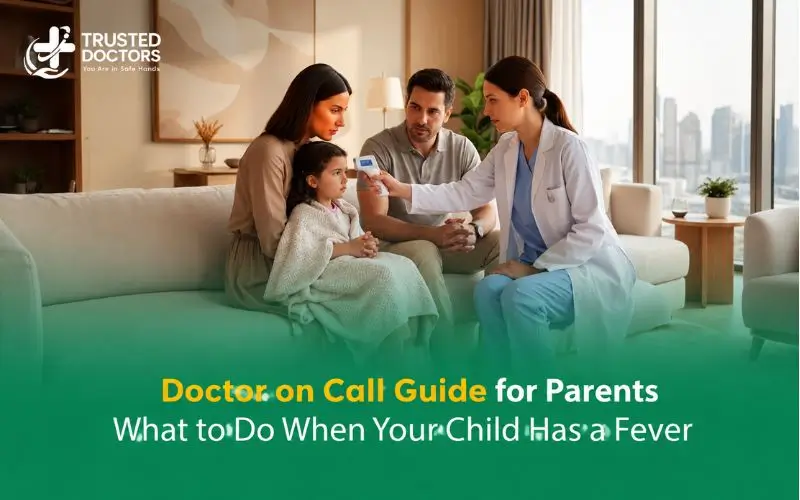
A child may appear perfectly normal in the evening and wake up later, becoming hot, restless, and not like themselves. This typically occurs without warning. Most parents will take a brief look at the temperature. Then there’s the time when they’re not sure what to do next. In such cases, a doctor on call service makes a difference. This enables parents to receive medical advice without having to travel.
Children often have fevers, but the fear that accompanies them is quite real, particularly at night or when there are many things to do, and it’s not easy to go to a clinic.

Understanding Support from a Pediatric Doctor at Home
A doctor-on-call service provides a pediatric doctor at the home when a child is not feeling well, and parents would prefer not to drive to the pediatrician’s office. The doctor visits the child’s home and assesses the child in the familiar environment.
This is an event that most families don’t plan for ahead of time. It’s typically a consideration they have once the situation has already been in progress.
It is used in many situations, including the following:
- Late-night fever.
- A child who is feeling unwell and is not able to walk about.
- Inconsistent decisions regarding whether a clinic visit is required
- Days when clinics do not feel open for appointments (such as weekends)
- Some parents believe that the service operates in a complicated manner. However, this does not happen in practice. The child doesn’t move, and the doctor works around the child’s environment, rather than changing it.
All children’s responses to sickness are individual. Others do not sleep and do not speak. Others get quiet or sleep more than normal. These changes in behavior may be easier to observe when the child is at home.
Why Home-Based Care Matters During Fever Episodes
Fever doesn’t always occur at a convenient time. It can be enjoyable when everyone else is very busy or closing.
Home-based care allows the child not to have to move at that time. Just that can help calm the chaos.
One area that parents notice is that children act differently at home than in other settings. They are less uptight, perhaps less honest, less talkative. This makes it easier to get the feel of what’s going on.
Child Fever Treatment at Home and What Parents Usually Notice First
Most home treatment of child fevers starts simply. Temperature is taken. Fluids are given. Afterwards, parents wait and watch to see what happens.
Fever doesn’t always look the same in children, and that’s where the confusion typically begins.
One child might remain seated and be able to ask questions. Another may not even want to get up. Temperatures of both can be the same.
Parents typically first notice the following changes:
- The child might not eat as much as normal and have less interest in eating.
- The child may experience prolonged sleep periods.
- The child may easily become upset or irritable at times, but seems normal in between.
- The child’s skin may be warm and sometimes sweaty.
- The child might be less energetic and not as active as normal.
Many times it’s as simple as letting it rest and time pass. Not necessarily right away, but over time.
When Symptoms Need Closer Attention
In certain situations, greater support is required. Home service by an emergency doctor is applicable in the following:
- Breathing changes
- Persistent vomiting
- Dehydration
- Drowsiness
- Seizures
The temperature is not the whole picture. The number on the thermometer is more likely to be a clue to behavior than the behavior itself.
Home Doctor Visit for Children: Why It Often Feels Easier
When kids visit their doctor at home, it’s a different experience for the family. A consultation is not done with an ill child, but rather at the child’s place of residence.
While this may not seem significant, it eliminates a lot of extra stress that accompanies clinic visits.
The following are reasons as to why parents opt for this choice:
- When the child is already ill, they don’t need to get dressed and move to the activity center.
- No travel, no waiting time – conserves the time of parents.
- Because no exposure to other sick people, infections are less likely to occur.
- A full discussion with the doctor about the child’s condition can take place, with the doctor and parents having more room to engage in the conversation.
- The entire experience is easy and more comfortable.
There’s another practical reason too that often is overlooked – children are more likely to recover better if they are not disturbed over and over. They don’t need to travel to and from work, and thus, they are not moving about unnecessarily, which allows them to sleep correctly.
Additionally, parents can be more concerned about their child rather than the logistics.
What Happens During Doctor on Call in Dubai Services
Often, a doctor on call in Dubai service is provided directly. Parents are made aware of what is happening, and a doctor on call Dubai visit is arranged, depending on the urgency.
It is frequently a process that includes the following steps:
- Call or mobile service provider.
- Briefly describe your child’s symptoms.
- Reconfirm the appointment by providing the location information.
- The arrival of a pediatric doctor arrives at home within a short time, with DHA certification.
- The child is assessed, and treatment advice is provided.
Most of the time, this happens for the first time in families when they happen to have an unexpected fever. Often at night. In some instances, when plans are already disturbed.
For many parents, it is not the difficulty that is the eye-catching aspect of the complexity, but the simplicity. The process seems easy; it’s not too complicated; it’s more or less simple.
There’s additional time during the consultation, too. Less rushing. Additional room to describe little details that might get lost.
Supporting Parents Through Uncertain Moments
This is a situation that all parents will face at some time: their child has a fever. If that is the case and it is an “uncomplicated” relationship, the first response is likely to be hesitation, not action.
At times, the signs are obvious. Other times, they aren’t. A child may not have any particular symptom to indicate that something is wrong, but he or she simply appears to be “off.”
In those cases, having medical input will help minimise overthinking. It provides guidance rather than speculation.
A doctor on call service just puts that help at your fingertips without having to leave home and wait for hours at the clinic.
Services that help people, such as those offered by Trusted Doctors, are part of this change in health care, which extends beyond treatment to timeliness and access.
Read Also: UAE Health Insurance