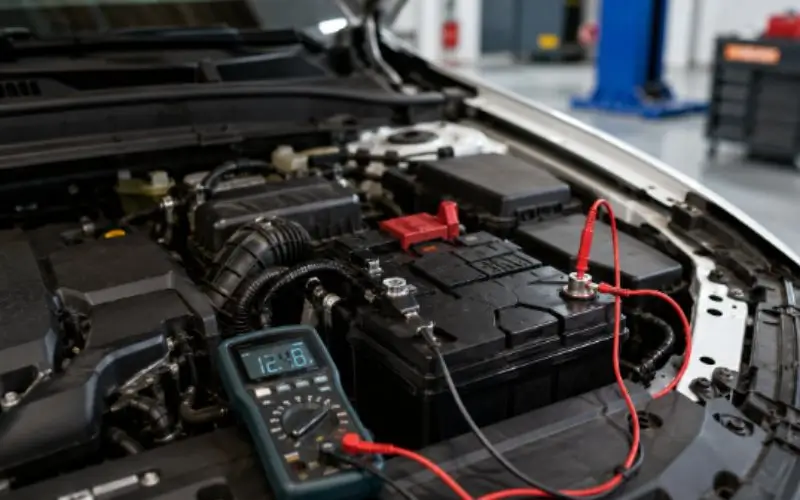
These are the days of computers on wheels! The consistent battery voltage is essential for every function, starting with the ignition of the electric motor to ADAS (Advanced Driver Assistance Systems). Multiple systems may be affected by a single voltage drop.
According to a 2021 study published in IEEE Transactions on Vehicular Technology, voltage instability is among the top 3 reasons for unexpected ECU failures in today’s cars. This is one of the reasons why the voltage stability of the car battery comes as more than a maintenance issue. It is a factor of performance and safety.
What Is Car Battery Voltage Stability?
When assessing the performance of a car battery, one of the most important characteristics is its voltage stability, which refers to the battery’s ability to maintain a steady voltage regardless of the electrical load. A car battery’s voltage stability is a key characteristic that determines its performance under various operating conditions, including low temperatures, at idle, and at peak electrical demand.
Common battery voltage in today’s cars:
- Engine OFF (resting): 12.4V to 12.7V
- Engine at idle (charging): 13.7V to 14.7V
- When under electrical load: should not drop below 12.2V.
If it is below 12.2V while under load, it is an indicator of poor battery condition. If the voltage gets below 11.8V, the whole electrical system can be at risk. The SAE International (SAE Technical Paper 2019-01-0589) research indicates that ECUs start to record phantom fault codes after 2 seconds if the supply voltage drops below 11.5V.
Why Car Battery Voltage Stability Impacts Engine Performance?
The electrical precision must be correct in order to get the best performance out of the engine. All fuel injection, ignition timing, turbo control, and airflow sensors are voltage-fed logic. It takes just 0.5V of instability to disrupt the entire cycle.
ECU Dependency on Stable Voltage
The ECU needs to be supplied with a steady 12V to 14.4V to determine correct ignition timing and fuel delivery.
When voltage drops or fluctuates:
- Ignition timing is no longer consistent, resulting in combustion efficiency losses of 3% to 7%.
- Fuel trim corrections are exceeded.
- When the engine is loaded, it takes 15 to 40 milliseconds to respond.
In a 2020 paper published in The Journal of Automotive Engineering, the researchers found that voltage levels under 12.0V resulted in ECU cycle-time errors in 78% of the vehicles they tested, including Toyota, BMW, and Ford platforms.
Fuel Injection System Sensitivity
In modern fuel injectors, the pulse width range is 1.5ms to 3.5ms, for both piezoelectric and solenoid types. When the voltage is low, the response time of the injectors will be slow, and the air-fuel ratio will be unbalanced.
Symptoms of poor injector voltage:
- Rough idle (RPM variation from the set above 50 RPM)
- There is an increase in fuel consumption of 8% to 12% per tank.
- Black exhaust while accelerating with a rich condition
Petrol Air-Fuel Ratio (AFR): The AFR of petrol is 14.7:1. Any delay in the injection process, even as short as 0.3ms, will cause the AFR to shift to 13.9:1 and result in incomplete combustion.
Sensor Network Disruption
New cars now have on board 60 to 150 sensors. Voltage instability results in incorrect sensor readings, warning lights, and temporary limp mode.
Sensors most affected by voltage drop:
- MAF (Mass Airflow Sensor): goes out of calibration at 12.0V or below.
- O2 (Oxygen Sensor): heater circuit is below 11.5V
- The signal-to-noise ratio decreases, and therefore, false retard is produced by the Knock Sensor.
For a healthy vehicle, the battery supply rail should have less than 50mV of AC ripple. Anything greater than 100mV AC ripple indicates a failing alternator diode, as confirmed by the SAE standard J537.
Ignition System Performance Fluctuation
To get the coils to full magnetic saturation, a steady supply of 12V to 14V is necessary. Low voltage is a reduction in the energy of the sparks and also increases the possibility of misfiring under load.
Effects of weak ignition voltage:
- The coil dwell time improves by 15%-20% and leads to coil overheating.
- The energy in the spark plug decreases from a desired 50mJ to less than 30mJ
- A misfire rate of 3 times higher at temperatures below 5°C.
The average primary resistance of an ignition coil is 0.5 ohm to 2.0 ohm, according to the Bosch Automotive Handbook (9th Edition). Peak sparks current decreases by as much as 22% at an 11.5V supply, which directly impacts combustion reliability.
Turbocharger and Air Intake Control Instability
Electronic turbo actuators and boost control solenoids are fast-acting (less than 20 milliseconds). This is a real-time control loop that is disrupted by voltage instability as low as 0.8V.
Results of unstable turbo control voltage:
- Increased pressure is 5-12 PSI higher than desired; potential for engine Knock.
- When accelerating, turbo lag rises by 200-400ms.
- VGT (Variable Geometry Turbocharger) vanes are stuck and do not move.
The study by Applied Energy (Vol. 265, 2020) demonstrates the same: A reduction of supply voltage below 12.1V under full load reduces the electronic actuator response error by 18%.
How to Improve Car Battery Voltage Stability?
Test the voltage every 3-6 months to improve car battery voltage stability, check alternator output, clean terminals, and replace AGM or lead acid batteries after 3-5 years of service.
Follow these 6 steps to maintain stable voltage:
- Check resting voltage at least once every 3-6 months. A healthy resting voltage is in the range of 12.4V to 12.7V. Use a digital multimeter with 0.01V resolution.
- Test the alternator at a low engine speed. The output is required to be 13.8V to 14.5V. Any voltage below 13.5V is an indicator of a weak alternator or brushes that are worn brushes.
- Remove sulfation and corrosion from battery terminals. The voltage drop under cranking conditions due to corroded terminals is 0.3V to 0.9V, and this brings 0.2 to 0.5 ohms of resistance.
- Turn off the AC, heated seat, and infotainment before turning the ignition. Short, low voltage (0.5V to 1 second) can be experienced during simultaneous start-up.
- Change the battery every 3-5 years. A typical flooded battery’s internal resistance increases from less than 5 milliohms (new) to more than 15 milliohms (aged) according to Battery Council International (BCI) standards.
- Check chassis, engine block, and body ground straps. The total voltage drop for the entire return path is 0.4V with a corroded ground.
Diagnostic Thresholds for Battery Voltage Health
The voltage benchmarks are used to check the condition of the battery by professionals. Use these thresholds to classify battery state:
Healthy Battery:
- Resting voltage: 12.6V to 12.7V (100% state of charge)
- Charging voltage: 13.8V to 14.5V
- Load voltage (200A cranking): above 9.6V for 15 seconds at 21°C (per SAE J537)
Warning Levels:
- 12.2V resting: 50% battery state of charge, battery requires charging
- 25% state of charge for 12.0V resting. 12.0V resting is recommended at 25% state of charge.
- Below 11.8V resting: WARNING-possible battery failure, replace battery.
Measure voltage only when the load is on, with a carbon pile load tester or a CCA (Cold Cranking Ampere) tester, and not at rest. A battery that charges to 12.6V, but drops to 9.0V when subjected to a 200A load, is damaged internally.
Why Voltage Stability Is More Important in Modern Cars Than Older Models?
Modern cars depend on ECU-controlled electronics for functions that older vehicles handled mechanically. Even a brief voltage dip can affect multiple systems at the same time.
| Feature / Aspect | Older Vehicles | Modern Vehicles |
| System Type | Mechanical ignition, carburetor | ECU-controlled fuel injection and ignition |
| Voltage Sensitivity | Low, minor drops ignored | High, 0.5V drop affects sensor accuracy |
| Engine Control | Points ignition or basic electronic | Real-time ECU with 100+ parameters |
| Sensor Count | 4 to 8 basic sensors | 60 to 150 sensors in advanced models |
| Effect of Voltage Drop | Minor performance loss | Misfires, limp mode, DTC fault codes |
| Diagnostics Needed | Basic multimeter | OBD-II scanner with live data logging |
Vehicles built after 2015 with CAN bus (Controller Area Network) architecture are especially sensitive. A CAN bus network requires a stable 5V reference signal from the ECU. If battery voltage dips, the 5V regulator may fail to hold the rail, causing sensor data loss across the entire network simultaneously.
Professional Diagnosis and Voltage Stability Assessment
Professional battery diagnosis requires 4 tools: CCA Tester, AC Ripple meter, parasitic draw tester, and OBD-II scanner with live voltage data logging.
Standard diagnostic procedure:
- Check for resting voltage before starting the engine.
- Compare CCA output to rated capacity (battery must have at least 80% CCA output)
- Test battery supply rail ripple (should be less than 50mV AC)
- Use OBD-II to scan for voltage-related DTCs (P0562 and P0563 are directly related to voltage faults).
- To measure parasitic draw, the engine should be off (acceptable parasitic draw is less than 50mA after 45 minutes sleep cycle).
At high temperatures (above 40°C), water evaporates from the battery, which increases the electrolyte concentration. According to data from Electrochimica Acta (Vol. 258, 2017), this raises the internal resistance as high as 30% over the operation when the temperature is 25°C. It is imperative to have a regular inspection in hot climates. It is critical.
In areas of high demand, such as Abu Dhabi, frequent inspections are even more important due to the high temperatures and constant electricity load. 800 Car Battery Replacement offers systematic diagnostics to ensure the health of the car’s battery, the accuracy of its charging system, and vehicle reliability over time, even in extreme driving environments, through the use of structured diagnostics and best services like Amaron Car Battery Abu Dhabi.
Final Thoughts
In all contemporary vehicles, the stability of the car battery voltage directly influences the performance of the engine, the accuracy of sensors, and the reliability of the electrical system.
Key facts to remember:
- Measurable ECU errors are present at 0.5V drops in supply voltage.
- Corroded terminals contribute up to 0.9V of voltage drop due to resistance.
- The internal resistance of batteries is 3x greater after 5 years.
- If the battery rail voltage is over 100mV with a ripple, the alternator diode is faulty.
- It is important to always check the voltage when fully loaded, not only when idle.
The need for a stable electrical system is NOT a luxury. For advanced vehicle engine management systems built since 2010, it is the base for all the other systems.
Read Also: